Martin Bell12 Min Read
10 Sole Proprietorship Business Ideas You Can Start With AI (2026)
A 2026 solo-founder guide to practical offers, AI-assisted delivery steps, validation signals, and risks to check before scaling.
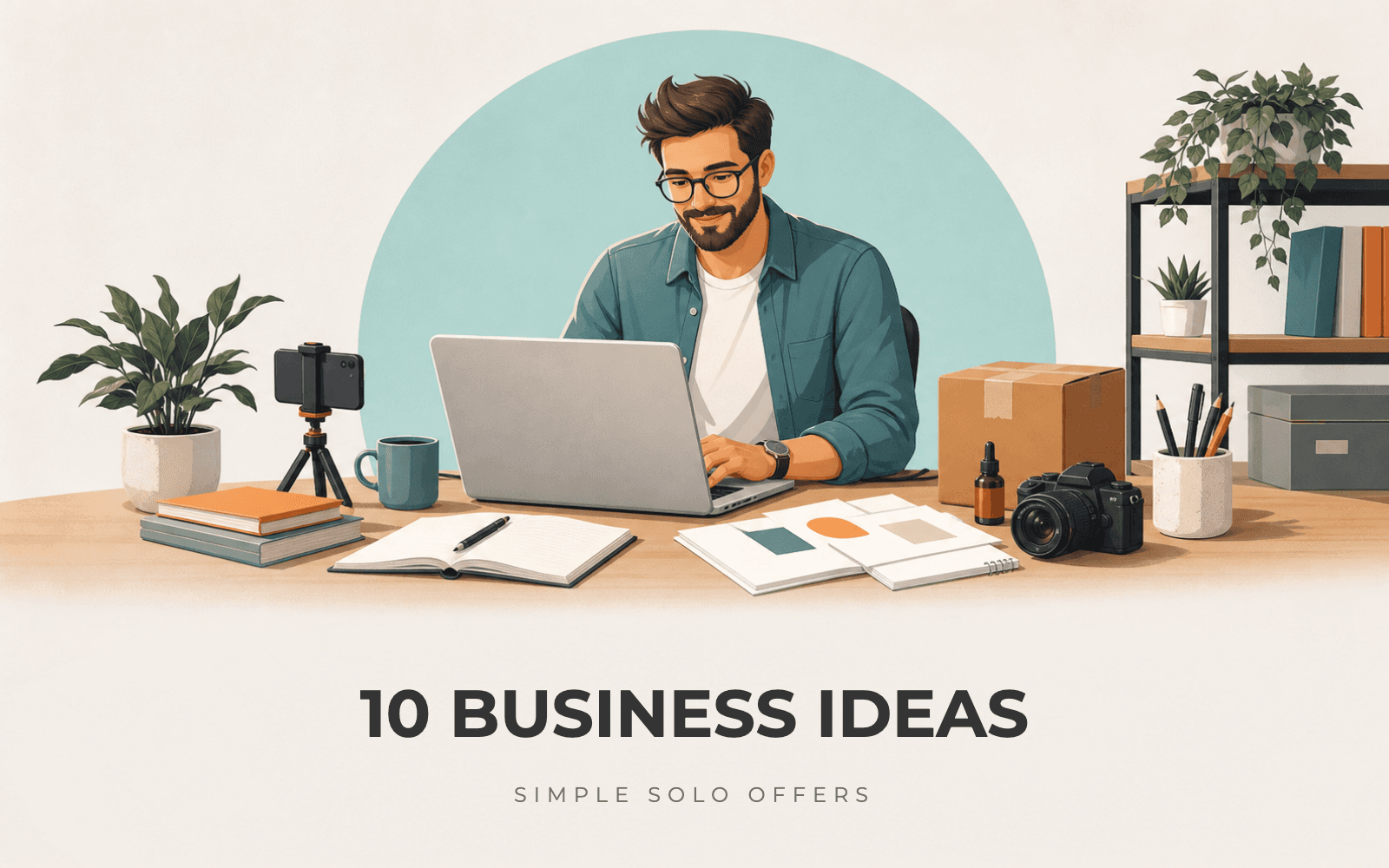
A sole proprietorship is one of the simplest ways to start a business. You do not need a complicated ownership structure, a board, or a large team to begin testing demand. One person can sell a service, product, digital asset, or local offer and learn quickly from real customers.
But simple does not mean casual. A sole proprietorship still needs a clear customer, a focused offer, a way to deliver value, and a basic understanding of legal and financial risk. AI can help one founder move faster through research, drafting, planning, content, customer support, and admin. It does not remove the need to validate the idea.
This guide gives you ten sole proprietorship business ideas that fit the 2026 founder environment. Each idea can start small, run with low overhead, and use AI as leverage without pretending that AI replaces customer judgment.
Key Takeaways
- A good sole proprietorship idea should be narrow enough for one person to sell, deliver, and improve.
- AI is most useful for research, drafting, organization, analysis, and repeatable delivery steps.
- Start with a simple paid offer before building a brand, course, software product, or full operation.
- Keep personal liability, contracts, tax, insurance, and business banking in view as the business grows.
- The best idea is the one you can validate with real customers quickly, not the one that sounds most scalable on paper.
What Makes a Good Sole Proprietorship Idea in 2026
The strongest sole proprietorship ideas have four traits.
First, the customer is reachable. A solo founder should be able to find prospects through local networks, LinkedIn, niche communities, search, referrals, or direct outreach.
Second, the offer is easy to understand. If the customer cannot explain what you do after one sentence, the offer needs work.
Third, delivery does not require a large team. You can use contractors later, but the first version should be something one person can control.
Fourth, the work creates a visible outcome. A client gets a cleaned-up booking process, a better product page, a month of content, organized receipts, a research report, a finished photo set, or a working template.
AI changes the economics of solo work because it reduces the blank-page burden. It can draft first versions, summarize research, organize notes, create checklists, and help you turn one customer interaction into reusable assets. The founder still needs taste, judgment, empathy, and follow-through.
1. AI-Assisted Freelance Writing for a Specific Niche
Freelance writing is a classic sole proprietorship idea, but the generic version is too crowded. The stronger 2026 version is niche-specific writing with a clear business outcome.
Examples include case studies for B2B SaaS companies, patient education articles for clinics, founder newsletters, product comparison pages, or grant narratives for nonprofits. The buyer is not paying for words. They are paying for clarity, trust, and saved time.
The first offer can be simple: one interview, one outline, one finished article, and one revision. AI can help with transcript cleanup, outline options, headline variations, and research summaries. You should still own the angle, structure, claims, and final edit.
Validate it by pitching one narrow deliverable to ten reachable buyers. A good signal is when a customer gives you source material and pays for a second piece.
Watch out for becoming a low-cost AI content operator. If the work can be replaced by a prompt, the margin will collapse. The value needs to be domain judgment and clear communication.
2. Product Photography and Listing Optimization
Small sellers need better product photos, descriptions, and listings. Many do not need a full agency. They need one person who can make their products look credible and help them sell more clearly.
This business can work for Etsy sellers, local food brands, makers, boutique retailers, or Amazon marketplace sellers. The first version can focus on a photo set and listing refresh for one product line.
AI helps with shot planning, listing audits, keyword ideas, description drafts, and comparison research. It can also help organize before-and-after examples for future sales. The actual quality still depends on lighting, composition, product handling, and honest positioning.
The first offer might be: ten edited product photos, three listing title options, a rewritten product description, and a simple conversion checklist.
Validate it by finding local sellers with weak product presentation and offering one product refresh. The strongest signal is measurable usage: they upload the assets, keep them live, and ask you to handle more products.
Watch out for promising marketplace ranking or guaranteed sales. Sell better presentation and clearer buying information.
3. Local Service Business Content System
Local service businesses often have real expertise but inconsistent content. A solo founder can turn owner knowledge into useful posts, emails, FAQs, and short scripts.
This works for dentists, tutors, accountants, gyms, repair shops, beauty studios, dog trainers, and local consultants. The business owner already knows the customer questions. They usually lack a repeatable publishing process.
The first offer can be a monthly content batch from one interview: four educational posts, two email drafts, ten social captions, and an FAQ update. AI can help transcribe the interview, extract themes, draft variations, and repurpose the material. You should keep the claims accurate and the tone natural.
Validate it by selling one fixed batch to one local niche. A good signal is a second-month renewal, not a compliment on the writing.
Watch out for turning the offer into vague social media management. Keep the promise tied to owner time saved, clearer answers, and consistent customer education.
4. Customer Interview and Insight Service
Many small companies say they want to understand customers, but they rarely run structured interviews. A solo founder can offer a customer insight sprint.
The service is straightforward: interview customers, summarize patterns, pull representative quotes, and recommend practical next steps. This is especially useful for founders, local service providers, consultants, and small B2B companies.
AI can help turn transcripts into themes, cluster objections, identify repeated language, and draft the final report. It should not replace the human judgment needed to ask follow-up questions or decide what matters.
The first offer might be five interviews and a short insight report. Keep it narrow. Do not promise a complete market research study.
Validate it by selling a small sprint to one business with an urgent decision: new offer, pricing change, landing page rewrite, churn problem, or product launch.
Watch out for fluffy findings. The report should lead to decisions: change the offer, improve onboarding, rewrite sales copy, add proof, or stop pursuing a weak segment.
5. Virtual Operations Cleanup
Solo operators, consultants, and small service businesses often run on messy tools, scattered notes, missed follow-ups, and inconsistent client handoffs. A virtual operations cleanup service fixes one workflow at a time.
The first offer should be specific. For example: "I clean up your client onboarding in two weeks" or "I turn your scattered project handoff into a simple repeatable system."
AI helps document processes, rewrite templates, summarize customer handoff notes, and generate checklists. The founder still needs to understand the business flow and simplify it.
The first deliverable can include a workflow map, intake form, client email templates, status tracker, and handoff checklist.
Validate it by finding businesses where the operational pain is visible. Missed appointments, repeated customer questions, delayed invoices, and messy file collection are all strong signs.
Watch out for becoming a general assistant. Productize the cleanup around one workflow and one result.
6. Niche Tutoring or Learning Support
Tutoring is a natural sole proprietorship because expertise can be sold directly. In 2026, the opportunity is not just one-to-one tutoring. It is structured learning support for a specific student, skill, or exam.
Examples include founder finance basics, spreadsheet skills for freelancers, English writing for non-native professionals, math support for a specific grade, or AI literacy for small business owners.
AI can help create practice questions, lesson outlines, summaries, and personalized review plans. It can also help track progress. The tutor still needs to explain clearly, diagnose confusion, and motivate the learner.
The first offer can be a four-session package with a simple before-and-after assessment. That is easier to buy than an open-ended hourly arrangement.
Validate it by selling a small package and tracking completion, referrals, and improvement. A strong signal is when learners ask for the next level.
Watch out for generic courses. A sole proprietor wins by personalizing the learning path and making the next step obvious.
7. Digital Template Shop for One Workflow
A digital template shop can be a strong sole proprietorship when it solves one specific workflow. The mistake is starting with a huge library. Start with one painful job.
Examples include proposal templates for consultants, onboarding checklists for coaches, inventory sheets for makers, budget trackers for solo founders, or customer interview scripts for early startups.
AI can help draft examples, generate use cases, create instruction variants, and turn customer questions into improvements. You should still test the template with real users before selling it widely.
The first offer can be one template bundle with a short guide and example filled-in version. The example is important because it shows the buyer how to use the asset.
Validate it with a small landing page, direct outreach, and ten conversations with the target audience. A purchase from a stranger is better than positive feedback from friends.
Watch out for template decoration. The template should help the buyer make a decision, complete a task, or avoid a mistake.
8. Solo Consultant for AI Tool Setup
Many small businesses know AI tools exist but do not know how to fit them into real work. A sole proprietor can help one type of business set up one practical AI workflow.
The offer should not be "AI consulting" in general. Make it concrete: AI-assisted customer support drafts for Shopify stores, proposal drafting for consultants, meeting-summary workflows for agencies, or content repurposing for local experts.
AI is obviously part of the delivery, but the value is process design. Which inputs are needed? Who reviews the output? What should never be automated? Where does the final work live?
The first offer can be a fixed setup package: workflow map, tool configuration, prompt templates, review checklist, and a training session.
Validate it by selling one workflow setup to one niche. A strong signal is when the customer actually uses it for two weeks and asks for the next workflow.
Watch out for over-automation. Small businesses need confidence and control, not a pile of prompts they do not trust.
9. Bookkeeping Prep and Receipt Organization
Many sole proprietors and small businesses do not need full accounting help at first. They need clean records, organized receipts, consistent categories, and a calmer handoff to a tax professional.
This can become a practical sole proprietorship if you position it carefully and stay within appropriate boundaries. You are not giving tax or legal advice unless you are qualified. You are helping organize information.
AI can help extract receipt details, categorize transactions for review, summarize missing documents, and create checklists. Human review is still essential because financial records need accuracy.
The first offer can be a monthly bookkeeping prep package: receipt organization, missing-document list, category review, and handoff folder.
Validate it by working with a few freelancers, creators, or local operators who already feel pain around financial admin.
Watch out for regulated work. Be clear about what you do and do not provide, and encourage customers to work with qualified professionals when needed.
10. Simple Website and Offer Packaging
Many solo businesses do not need a complex website. They need a clear offer, credible proof, a booking path, and a page that answers buyer questions.
A sole proprietor can specialize in simple website and offer packaging for one audience: coaches, tutors, local service providers, consultants, or creators launching a paid service.
AI can help draft page sections, turn customer notes into FAQs, generate positioning options, and create first-pass copy. The founder should interview the customer, shape the offer, edit the claims, and make the buying path simple.
The first offer can be a one-page site package: offer definition, landing page copy, simple design, booking link, FAQ, and two follow-up email templates.
Validate it by selling to businesses that already have customers but weak online presentation. That way, you are not inventing demand from scratch.
Watch out for selling design alone. The value is not just making a page look better. The value is making the offer easier to understand and buy.
How to Choose the Right Sole Proprietorship Idea
Start with what you can sell and deliver this month.
Pick three ideas from the list. For each one, write the customer, painful workflow, first offer, price range, and first validation step. Then choose the idea where you can reach real prospects fastest.
Do not spend weeks building a brand before you know whether people care. A simple outreach message, landing page, or paid pilot can teach more than a polished logo.
Use AI to move faster through the work: research the niche, draft outreach, summarize interviews, prepare checklists, and organize your first delivery process. Then talk to customers. The learning does not happen inside the tool. It happens when the market reacts.
100 Tasks AI is built around that same discipline: move through the right startup tasks in the right order, use AI to accelerate execution, and keep the founder's judgment in the loop.

Martin Bell
Startup-building guidance from the 100 Tasks framework.